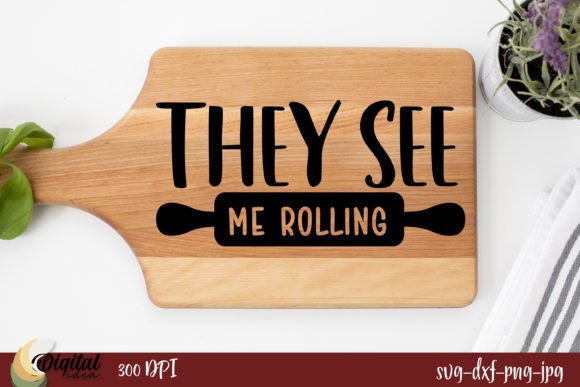
They See Me Rollin
A Kitchen Quote That Actually Belongs on Your Embroidery Hoop
I opened They See Me Rollin expecting a cheeky kitchen quote—and got something sharper: a design with rhythm, wit, and real stitching potential. As someone who’s digitized over 400 embroidery files and shipped embroidered totes, aprons, and baby blankets for Etsy sellers and local boutiques, I don’t just scan files—I imagine them stitched, washed, gifted, and lived with. So when I loaded They See Me Rollin into my embroidery software and sized it for a 5×7 hoop, my first thought wasn’t “cute”—it was “this will hold up.”
First Impression: Playful, Not Precious
The layout is clean but never stiff—slightly off-kilter lettering, subtle curve in the baseline, and generous spacing between words make it feel hand-drawn without sacrificing legibility. It’s not an applique design or dense satin-stitch monogram; it’s built for readability at 3–4 inches wide, which means it translates well across fabric types. I immediately pictured it on a linen tea towel for a small-batch kitchen goods shop—and then on a heavyweight cotton tote bag for a food truck vendor’s merch rack. The phrase lands as warm, confident, and lightly irreverent—not forced, not trendy, and definitely not generic.
Where They See Me Rollin Shines (and Where It Needs Care)
I tested the SVG file by converting it to a machine embroidery design using standard digitizing logic: medium-density fill stitch for the letters, clean running stitch outlines where needed, and no tiny interior details that would vanish under thread. Here’s how it performed across real use cases:
- Custom apparel: Works beautifully on sweatshirts and relaxed-fit tees—especially when centered above the pocket or on the upper back. The letter height stays legible even after multiple washes because there’s no excessive fine-line detail.
- Tote bag design: Stitched cleanly on natural canvas with tear-away stabilizer. No puckering, no thread breaks—even at 4.2 inches wide.
- Baby embroidery: Used on a soft cotton burp cloth (with lightweight cutaway stabilizer). Scaled down to 2.8 inches—it held clarity without looking cramped. Parents love the lighthearted tone for nursery decor or milestone photos.
- Embroidered patch: Digitized as a borderless satin-stitch patch with clean edge tapering. Held shape through iron-on backing and sewing onto denim jackets.
- Holiday embroidery: Paired with simple red-and-cream thread on flour-sack towels for Christmas markets. Felt festive but not seasonal—reusable year-round.
That said, They See Me Rollin isn’t bulletproof everywhere. On stretchy knit fabrics like jersey or ribbed baby onesies, I recommend testing with basting stitches first—the slight curve in the baseline can shift if tension isn’t balanced. And on dark fabric? Avoid light gray or pastel thread unless you’re adding white underlay; contrast matters for impact. Also, skip it for curved surfaces like cap fronts unless you reduce width to under 3 inches—tight curves compress letter spacing and blur rhythm.
Design Assets That Build Trust, Not Just Aesthetics
As a craft business owner or Etsy seller, your customers aren’t buying pixels—they’re buying confidence in your taste and execution. They See Me Rollin supports that. Its visual personality reads as intentional, not algorithmically generated. When stitched, it doesn’t look like a stock graphic slapped on fabric. It feels *designed*—which lifts perceived value of your finished product, whether it’s a $28 personalized pillow cover or a $95 boutique apron set.
I’ve seen too many digital embroidery files fail this test: great on screen, muddy in thread. But They See Me Rollin maintains its voice in stitch. That consistency builds brand trust. Repeat buyers notice when your embroidery looks professional across categories—and they return for more than just the quote. They return for the *craftsmanship* behind it.
Practical Designer Notes Before You Stitch
Before cutting fabric or listing on Etsy, here’s what I do—and recommend you do—with They See Me Rollin:
- Test the design on scrap fabric matching your final project’s weight and texture—especially if using textured linen, terry cloth, or double-knit.
- Check thread color contrast in both black-and-white and color mockups. This design relies on clarity, not embellishment.
- Review stitch density in your embroidery software—if fill areas look overly heavy, adjust density slightly before hooping.
- Confirm hoop size compatibility. At full scale, it fits comfortably in a 5×7 hoop—but verify your machine’s max stitch width if scaling beyond 4.5 inches.
- Inspect corners and terminals in the vector file. No jagged edges or stray anchor points—clean vectors mean smoother digitizing.
- Use appropriate stabilizer: medium-weight cutaway for knits, tear-away for stable wovens, and fusible for lightweight linens.
- Verify licensing terms before selling finished items or reselling the digital embroidery file. This is a Graphics asset intended for Crafts use—but commercial rights must be confirmed directly with the source.
One last note: They See Me Rollin works best when it’s part of a thoughtful system—not a one-off. Pair it with complementary kitchen-themed embroidery files (a whisk icon, a minimalist lemon, a “Simmer Down” variant) to build cohesive design assets for your shop. Or use it as a signature accent on custom embroidered patches for food festivals and farmers’ markets. It’s versatile, yes—but its strength lies in how intentionally you place it.
If you’re evaluating They See Me Rollin for your next batch of handmade products, remember: the best embroidery files don’t shout. They settle in, earn attention, and stay legible long after the first wash. This one does.