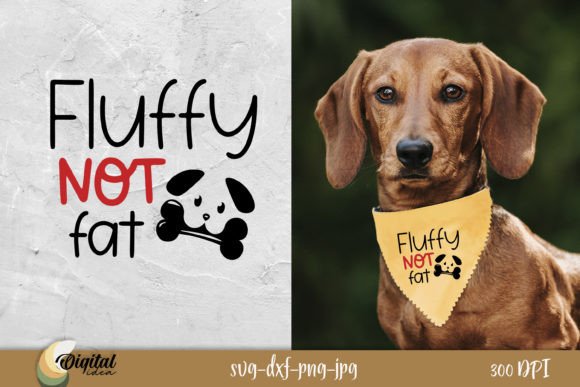
Fluffy Not Fat: A Designer’s Real-World Embroidery Review
As someone who’s stitched hundreds of custom pieces—from boutique baby onesies to Etsy best-selling tote bags—I opened the Fluffy Not Fat design with quiet curiosity. Not hype, not hope—just the practiced eye of a designer who knows how easily a charming concept can unravel under needle and thread. This isn’t just another dog quote SVG; it’s a potential workhorse for your craft business, a tiny personality boost on a sweatshirt, or the playful heart of a holiday ornament set. So let’s talk about what Fluffy Not Fat actually does—and doesn’t—do well in real embroidery.
First Impressions: Friendly, Clean, and Built for Clarity
The moment you preview Fluffy Not Fat, its tone lands instantly: warm, tongue-in-cheek, and visually uncluttered. The lettering is rounded but legible, with gentle spacing and no fussy serifs or overlapping elements. There’s no dog illustration tacked on—just the phrase itself, styled like friendly hand-lettering. That simplicity is its biggest strength. It reads clearly at 3” wide on a tea towel, holds up at 1.5” on a baby cap, and won’t drown in dense fill stitches. As a machine embroidery design, it leans into satin stitch for crisp edges and minimal running stitch for subtle outlines—ideal for clean, confident stitching without excessive density.
Where It Shines: Real Projects, Real Customers
Last week, I prepped a batch of organic cotton aprons for a local bakery’s staff gift set. I chose Fluffy Not Fat for the pocket—small (2.25”), centered, stitched in soft oatmeal thread on charcoal linen. Why? Because it added warmth without cutesiness, and customers immediately smiled—not at the dog reference, but at the gentle wit. That’s the magic: Fluffy Not Fat works because it feels handmade, not mass-produced. It fits naturally on:
- Custom apparel like crewneck sweatshirts and relaxed-fit tees (especially for pet-loving small businesses)
- Embroidered patches meant for jackets or tote bags—its balanced weight prevents curling or stiffness
- Baby embroidery projects where subtlety matters (think: onesie chest or burp cloth corner)
- Holiday embroidery—stitched in metallic gold on velvet ornaments or stitched simply on linen pillow covers
- Etsy seller listings where visual clarity in digital mockups matters as much as the finished product
It also translates beautifully into printable mockups. Whether you’re building a digital product preview for your craft business or drafting a listing for a handmade shop product, the clean vector forms (SVG, EPS, PDF) scale without pixelation—and the PNG/JPEG files hold contrast well against light and dark backgrounds.
Where to Pause: Texture, Fabric, and Functionality
That said, Fluffy Not Fat isn’t bulletproof—and pretending it is would do your customers a disservice. On highly textured fabrics like bouclé or thick terry cloth, the letterforms can soften at the edges. On stretchy knits, even with light cutaway stabilizer, the curves may subtly distort unless hooped with care. And while the design avoids ultra-thin lines, the inner counter of the “o” and “a” are modest in size—so if you’re stitching at under 1.25”, test first. Tiny hoop sizes (under 3”) demand attention to stitch density: too tight, and the satin stitch loses breathability; too loose, and the shape blurs.
Dark fabric? No problem—but confirm your thread color has enough contrast. I ran a test on navy twill using heather gray thread: readable, yes, but less joyful than the same design in creamy white. For commercial embroidery, that nuance affects perceived value. And while Fluffy Not Fat isn’t an applique design, don’t force it into layered garments (like quilted jackets) without checking clearance around seams and zippers—it’s designed to sit flat, not conform to complex contours.
Design Integrity Meets Customer Trust
Here’s what matters most to buyers: authenticity. When someone purchases a personalized gift or boutique product, they’re buying intention—not just ink or thread. Fluffy Not Fat supports that. Its restraint makes it feel considered, not generic. It elevates a plain kitchen towel into something giftable. It adds quiet charm to a nursery decor piece without veering into kitsch. That builds trust—not just in your craftsmanship, but in your taste.
For Etsy sellers and creative entrepreneurs, this design quietly strengthens brand consistency. Use it across a line of pet-themed merchandise—bandanas, ornaments, mugs—and it becomes a recognizable motif, not a one-off graphic. But only if applied with intention: consistent sizing, thoughtful thread palette, and appropriate fabric pairings.
Practical Notes Every Embroidery Designer Should Keep Handy
Before you load Fluffy Not Fat into your embroidery software or list it in your shop:
- Test on scrap fabric first—especially if working with textured, stretchy, or dark materials
- Check thread color contrast in natural light, not just on screen
- Review stitch density in your editing software—if it looks heavy in preview, simplify fill areas or adjust underlay
- Confirm hoop size compatibility for your intended use (e.g., 4×4 for baby items, 5×7 for tote bags)
- Inspect small details like interior curves and spacing—zoom in, stitch out, compare
- Test black-and-white mockups to ensure readability across backgrounds
- Use proper stabilizer: tear-away for stable wovens, cutaway for knits, lightweight for delicate fabrics
- Verify licensing terms before selling finished items or bundling the digital embroidery file—this applies whether you’re a craft business or a solo maker
Fluffy Not Fat belongs in the Crafts category not because it’s decorative, but because it serves function with grace. It’s a graphics asset that earns its place—not by shouting, but by fitting seamlessly into real lives, real products, and real hands.